
Gutter guards

Gutter Guards and Leaf Protection in Central Florida

Gutter guards sit over your gutters to keep leaves, pine needles and other debris out while letting rain through. They can cut down how often you need to clean, though no guard removes maintenance entirely. We install leaf protection systems and gutter screens.

Request a Free EstimateCall 407-879-5382

At a glance

  • Less time on a ladder
  • Fewer clogs
  • Helps with trees
  • Keeps debris out of downspouts

The basicsWhat are Gutter Guards

A gutter guard is a cover or screen over the gutter opening. Water flows through or around it into the gutter, and larger debris stays on top or slides off.

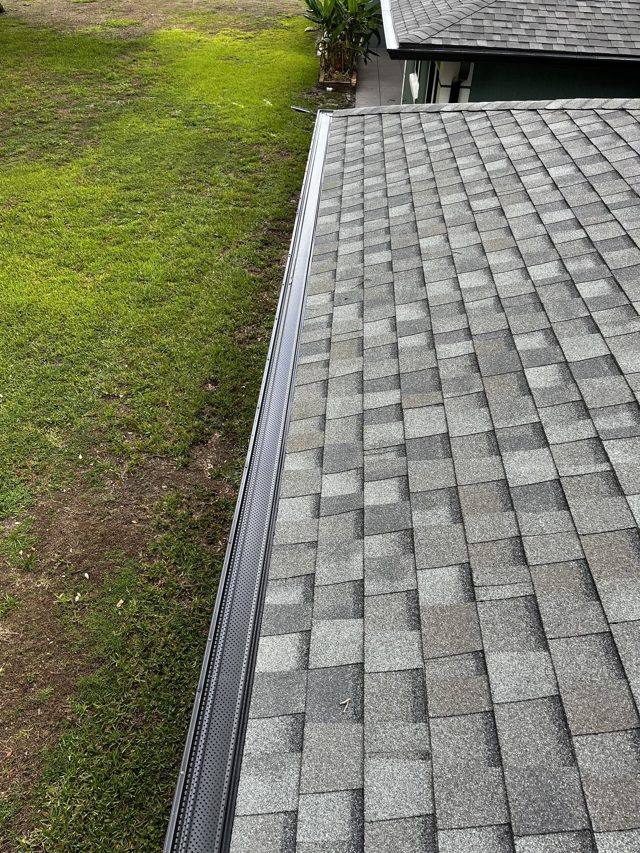
There are several types. Brush and foam inserts sit inside the gutter. Mesh screens cover the opening and block medium and large debris. Micro-mesh has much smaller openings and filters fine material such as roof grit and pine needles. Reverse-curve guards shed debris over a curved top while water follows the curve into the gutter.

Each has trade-offs. Foam can degrade and hold moisture, and basic mesh can let small debris through. Micro-mesh tests well but is harder to fit precisely. Reverse-curve styles are bulkier and can struggle in very heavy rain.

Black micro-mesh gutter guard along the edge of a shingle roof

Why it mattersBenefits

Less time on a ladder

Fine mesh guards are often described as cutting cleaning to about once a year or every other year instead of every six months.

Fewer clogs

Keeping leaves and needles out helps prevent overflow and slow drains.

Helps with trees

They are most useful where branches overhang the roof and drop leaves, seeds or needles.

Keeps debris out of downspouts

Material that never enters the gutter cannot jam an outlet.

Less pest habitat

A cover reduces the standing debris that attracts insects and nesting.

Fits many gutter types

Guards can be matched to your gutter size and style.

How it worksThe installation process

  1. Look at your trees and roof

    We note what falls on your roof, how much of it, and how the roof sheds water into the gutters.

  2. Choose the guard type

    We discuss options and match one to your gutters, debris and the volume of water your roof sends.

  3. Clean the gutters

    Existing debris is cleared so the guard starts on a clean gutter.

  4. Fit the guard

    Guards are cut and fastened to the gutter or tucked under the shingle edge, depending on the style.

  5. Check drainage in heavy rain conditions

    We confirm that water enters the gutter and flows to the downspouts.

  6. Plan the upkeep

    We explain how often to check and rinse the guards.

Is it right for you?Is it right for your home?

Often a good fit when

  • Trees hang over your roof and drop leaves, needles or seed pods.
  • You are tired of cleaning gutters or do not want to climb a ladder.
  • Your gutters overflow because debris keeps clogging the outlets.
  • You have pine needles or fine roof grit that clog open gutters.

Worth thinking about

  • No guard eliminates maintenance. Independent testing has found guards still need occasional upkeep, because debris can pile up on top and block water.
  • Finer mesh can build up a film on the surface and may need a rinse or brush a couple of times a year.
  • Some guard styles can handle large water volumes poorly, so roof size and pitch matter. Tell us about your roof and trees.
  • Some roof warranties have requirements for what is attached near shingles, so check yours.

Pricing and upkeepCost and care

What affects the price

  • Linear feet of gutter
  • Guard type and material
  • Gutter size and shape
  • Roof height and access
  • Condition of the existing gutters
  • Whether the gutters need cleaning or repair first

We give you a free written estimate after we see the home, so you know the number before any work starts.

Keeping it in shape

Inspect guards each season and after major storms. Clear thick buildup, and rinse with a garden hose or soft brush about every six months to prevent blockages.

FAQsQuestions we hear

Do gutter guards really work?

They can reduce how much debris gets into the gutter and how often you clean. They are not maintenance-free, though, and results depend on the guard type, your trees and your roof.

Which type of gutter guard is best?

It depends on what falls on your roof. Micro-mesh handles fine debris well, mesh screens handle larger leaves, and reverse-curve styles shed debris but can struggle in very heavy rain. We recommend one after seeing your home.

Will I still need to clean my gutters?

Probably occasionally. Most guards still need inspection after storms and a rinse now and then so debris does not build up on top.

Can guards be added to my existing gutters?

Often yes, if the gutters are in good shape and sized for the guard. If the gutters are sagging or leaking, we may recommend repairing or replacing them first.

Can guards cause overflow in heavy rain?

Some styles can, especially if they are not matched to the roof or if debris builds up on top. That is one reason to choose the guard for your roof and keep it clean.

Where we workAvailable across four counties

We provide this service for homes in Brevard County, Orange County, Osceola County and Polk County. Each county page lists the communities we serve there, with local notes for homeowners.

Keep readingRelated services

Gutter Cleaning & MaintenanceSeamless K-Style GuttersDownspoutsWhere we work

Where this came fromSources

General information on this page comes from these industry and manufacturer sources. Details on your home depend on the home itself, which we look at in person.

Ready when you areGet your free estimate today

Tell us about your project and we'll take care of the rest. No pressure, no obligation.

Get a Free EstimateCall 407-879-5382
BBB Accredited Business