
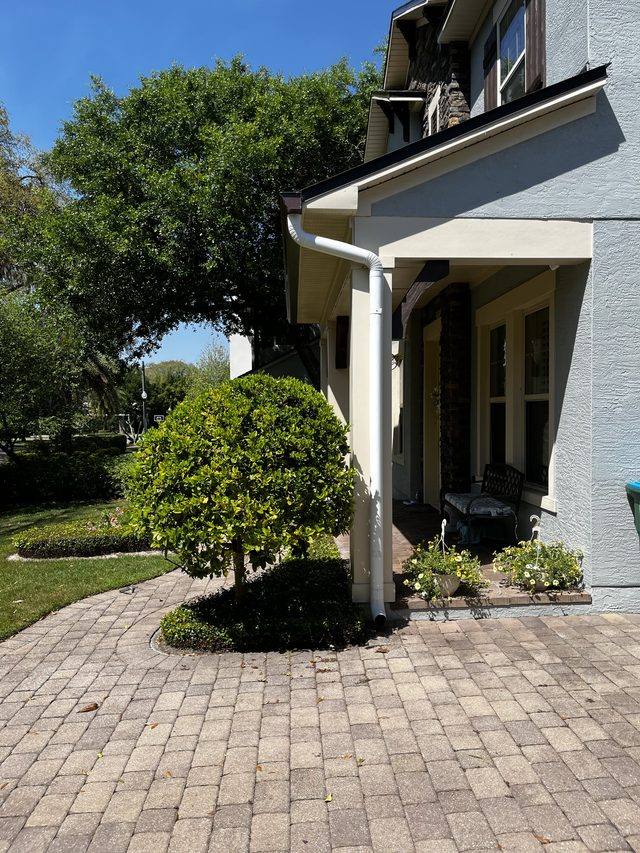
Water leaves the house
Properly placed downspouts and extensions send roof water away from the foundation, walkways and landscaping.
A downspout is the vertical pipe that carries water from the gutter down to the ground. Where it ends up is just as important as the gutter above it. Water released right at the wall can soak the soil beside the foundation, wash out mulch and stain siding.
Home-improvement guidance generally recommends sending water at least 4 to 6 feet away from the foundation, and farther where drainage is poor or runoff is heavy. That distance is usually reached with an extension, a longer pipe run, or an underground drain line.
We install and replace downspouts, add extensions, and place splash blocks where they make sense for your lot.
Properly placed downspouts and extensions send roof water away from the foundation, walkways and landscaping.
Controlled discharge means less splashing, staining and washed-out planting beds.
Enough outlets spread the load, so one run is not carrying more water than it can handle.
We plan outlets and discharge points around where your yard actually drains.
Dented, crushed, sagging or disconnected downspouts can be swapped without redoing the whole system.
Extensions, splash blocks and underground drains each fit different yards.
We check how your roof drains, where water lands, and which outlets are overloaded.
A common rule of thumb is one downspout per about 30 feet of gutter, with more on steeper roofs. Corners and valleys, where water collects, are good locations.
New downspouts are attached to outlets and secured to the wall, or damaged ones are removed and replaced.
We add the discharge method that suits the spot, such as an extension or a splash block.
Extensions should slope downward at least about a quarter inch per foot so water keeps moving.
We confirm water leaves the gutter, runs through the pipe, and exits where intended.
We give you a free written estimate after we see the home, so you know the number before any work starts.
Check downspouts after storms. Make sure the top is free of debris, the elbows are connected, and the bottom still discharges away from the house. Flexible extensions can crack or collapse over time.
We provide this service for homes in Brevard County, Orange County, Osceola County and Polk County. Each county page lists the communities we serve there, with local notes for homeowners.
General information on this page comes from these industry and manufacturer sources. Details on your home depend on the home itself, which we look at in person.